Real estate document management isn't about pretty folders. It's about not losing a TRID-deadline contract two months after closing, not having an addendum quietly evaporate from someone's email thread, and being able to prove what was signed and when if your broker, your client, or a state board ever asks.
DocJacket is real estate document management software built around two things most tools skip: a real audit trail (immutable storage, not “we have backups”) and AI that reads contracts so you don't retype them. Built for transaction coordinators, agents, and brokers who actually handle the documents.
Try DocJacket free — early customer pricing is $29/mo for 2 coordinator seats; standard pricing will increase to $49.
What real estate document management software should actually do
Five jobs every real estate document management tool should do. Most do one or two well and gesture at the rest.
Capture every document tied to a transaction. Contracts, addenda, disclosures, inspection reports, lender docs, closing disclosures, email correspondence — all attached to the deal, not scattered across folders, drives, and inboxes.
Read the documents. Extract dates, parties, prices, and contingencies so you don't retype them into three different systems. The contract is the source of truth — the software should treat it that way.
Store them so they can't be edited or deleted. Immutable storage with a retention schedule. This is the part that matters when an audit shows up or a lawsuit gets filed two years after closing.
Make them findable. By transaction, by client, by date, by document type, by keyword inside the document.
Share them safely. With clients, agents, lenders, and attorneys — without giving everyone full read-write access to the file room.
Most “document management” in real estate is just shared folders with version numbers. That's storage. This is management.
Why WORM-compliant storage matters
WORM stands for Write Once, Read Many. Once a document is archived, it cannot be modified or deleted during the retention period — by anyone. Not the agent. Not the broker. Not DocJacket. That's the point.
Real estate transactions need this for four reasons that show up in the real world:
- State recordkeeping laws. California Code of Regulations § 2729 requires brokers retaining records electronically to use non-erasable, tamper-evident storage — what the industry calls WORM. Many other states have analogous electronic recordkeeping rules. “We had it on Dropbox” is not a defensible answer.
- Broker E&O insurance audits. E&O carriers commonly ask for proof that closed transactions are retained, immutable, and produceable on demand. A folder of PDFs that anyone could have edited last Tuesday doesn't qualify.
- Lawsuit defense. If you're sued in 2027 over a 2026 transaction, the contract you produce in discovery has to be provably the contract that was signed. Immutable storage with a full audit trail is the only credible answer.
- Retention requirements. Most states require five to seven years of transaction record retention; some longer. Documents need to be stored in a form that survives an audit — not a shared drive, not an agent's laptop.
Built-in. Not a third-party add-on.
DocJacket stores final transaction documents on enterprise-grade immutable cloud infrastructure — non-erasable, tamper-proof, retained for the full required period. Automatically.
No add-ons, no extra cost, no third-party vendor to manage. WORM-compliant archiving is part of the product, not an upsell.
- Immutable archive of every final document
- Configurable retention per state (default 7 years)
- Full audit log of every view, download, and edit
- Encrypted at rest and in transit, U.S. data centers
AI document extraction — the part that saves you hours
The boring truth about transaction work: TCs and agents spend hours retyping data from contracts into checklists, calendars, and CRMs. Names, dates, prices, addresses, contingencies — manually transcribed every single time, on every single deal.
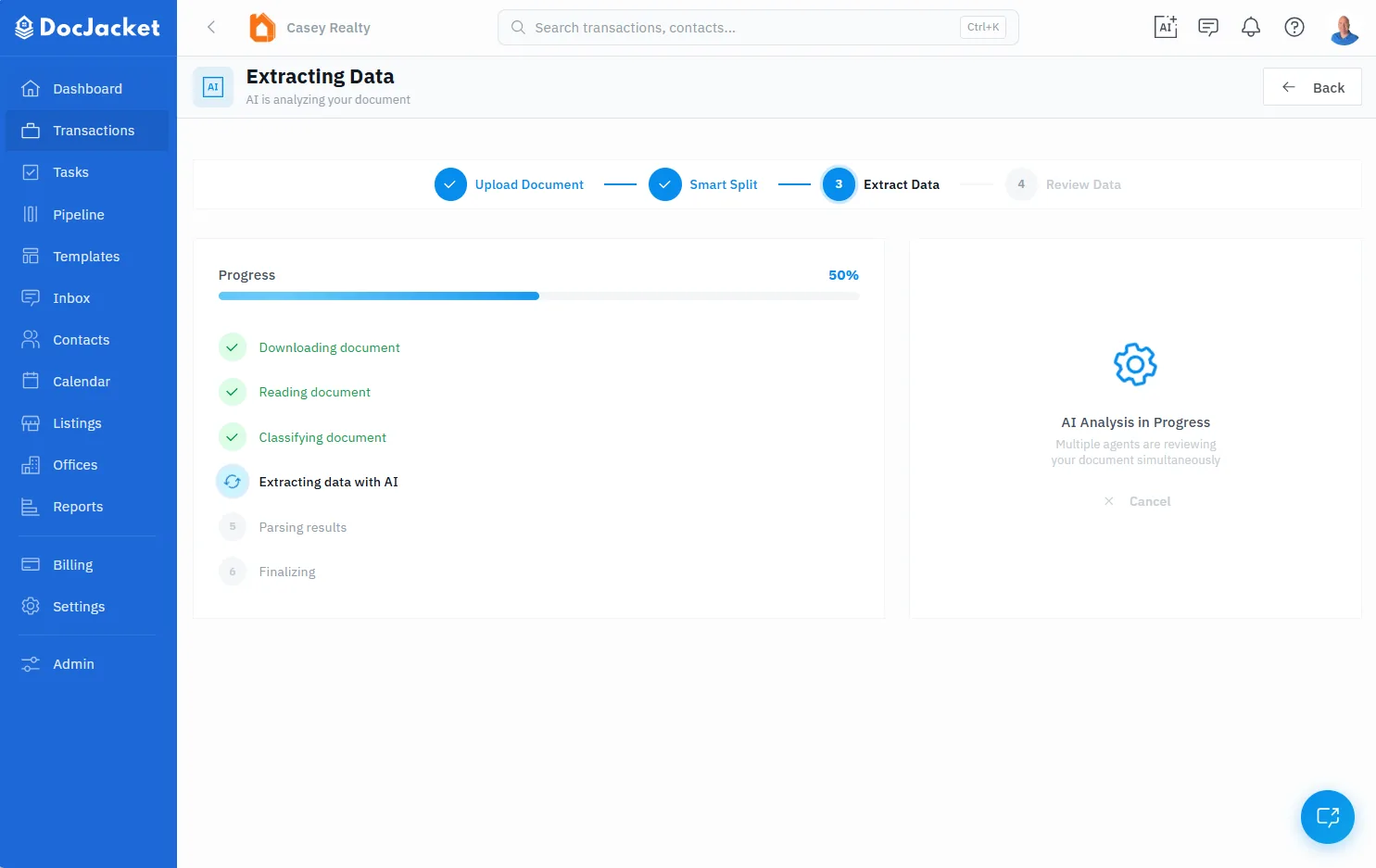
DocJacket reads the contract for you. Upload a PDF — signed or unsigned, scanned or digital — and the AI extracts:
- Buyer and seller names
- Subject property address
- Sale price and key financial terms
- Critical dates: acceptance, inspection, financing, appraisal, closing
- Contingencies and contingency removal dates
The DocJacket tagline: AI preps. You approve. We don't trust the AI blindly. It extracts; you review; you confirm. Every extracted field gets logged into the audit trail with who confirmed it and when.
The compliance angle is the part most AI tools miss. Extracted data flows into audit-tracked fields — the AI doesn't bypass the audit trail, it feeds it. Unlike workflows where data lives in someone's head until they retype it into three systems, DocJacket's extraction creates a single source of truth from the moment the contract hits the platform.
What you can store and manage in DocJacket

Listing agreements
Original signed agreements with the agent of record, retained for the full required period.

Purchase contracts
Executed purchase agreements with parties, dates, and price extracted automatically.

Addenda and amendments
Every change attached to the parent contract — version-tracked, never overwritten.

Disclosure forms
State-required disclosures, lead-paint, HOA, mold — categorized and audit-tracked.

Inspection reports
Home, pest, roof, sewer scope — uploaded once, accessible to every authorized party.

Lender documents and approvals
Pre-approval letters, loan estimates, commitment letters, clear-to-close notifications.

Title commitments and closing docs
Title commitments, closing disclosures, settlement statements, deeds.

Email correspondence
Client and agent communication captured against the transaction, not buried in inboxes.

Custom document categories
Every brokerage handles deals differently. Add your own document types as needed.
Every document is stored as both an e-signed and an uploaded version where applicable, so the original signed PDF and any working copies are both preserved with full version history.
Built for solo TCs and self-coordinating agents — not enterprise IT
Most “real estate document management” software is enterprise-focused. Lone Wolf, SkySlope, brokerage-grade tools with brokerage-grade pricing. Per-agent fees, implementation calls, training requirements, multi-year contracts. Built for the broker, sold to the broker, deployed across an entire firm. Great if you're running a 500-agent franchise. Overkill — and overpriced — if you're the person actually doing the work.
DocJacket is built for that person. The transaction coordinator running a one-person shop. The self-coordinating agent handling their own files. The solo broker doing all three jobs at once.
- $29–$49 per month including 2 coordinator seats, then per additional seat — no per-agent fees
- Set up yourself in an afternoon — no implementation team, no training calls
- Unlimited transactions, unlimited agents on the free Agent Portal, unlimited clients on the free Client Portal
- Cancel any time, no annual contract
Need to check TRID timing on a specific transaction? Use the free TRID date calculator to compute Loan Estimate deadlines, Closing Disclosure presumed-receipt dates, and the earliest legal closing date under the federal 3-business-day rule.
For brokers running their own deals, see transaction management for brokers. For TCs specifically, see transaction coordination software, the best transaction coordinator software for 2026, and document management for transaction coordinators specifically. For the broader category comparison, see our transaction software comparison. Or jump straight to pricing.
Frequently asked questions
Common questions
Real estate document management software is the system a brokerage, transaction coordinator, or agent uses to capture, organize, archive, and share every document tied to a real estate transaction — contracts, addenda, disclosures, inspection reports, lender docs, closing disclosures, and email correspondence. The category overlaps with general document management but adds real estate-specific requirements: state recordkeeping laws, immutable archiving, transaction-level organization, and role-based sharing for buyers, sellers, agents, lenders, and attorneys.
For day-to-day file sharing, yes. For real estate compliance, no. Google Drive and Dropbox aren't WORM-compliant by default — files can be edited or deleted at any time, which doesn't meet electronic recordkeeping rules like California § 2729. They also don't track transaction-level context, retention schedules, or per-document audit trails. Useful for working copies; not sufficient as the system of record for a closed transaction.
Storage is where documents live. Management is what happens around them — capture, extraction, categorization, audit trail, retention, access control, search, and safe sharing. Dropbox is storage. A folder named “2026 Closings” on a shared drive is storage. Real estate document management software is the system that runs the lifecycle of a transaction document — from the moment a signed PDF lands in your inbox to the moment it's archived, immutable, on a retention schedule a state board would accept.
Yes. Documents are stored in WORM-compliant immutable storage — write once, read many. Once a final document is archived, it can't be modified or deleted during the retention period, meeting real estate recordkeeping requirements like California Code of Regulations § 2729 and similar rules in other states. See security and compliance details.
Native integrations today: Gmail and Outlook for email correspondence capture, Google Calendar and Outlook Calendar for deadline sync. Documents from any source can be uploaded — DocuSign-signed PDFs, Dotloop exports, MLS forms, scanned PDFs, anything in PDF or image form. Zapier and additional integrations are on the roadmap.
Retention is configurable per state. The default is seven years (the floor in most states), accommodating California § 2729, Texas TREC requirements, and similar state rules. Longer retention can be configured for state-specific or brokerage-specific requirements. Once retention expires, documents remain in immutable storage unless explicitly purged through a documented, audit-logged process.
Role-based access. Coordinators with a paid seat have full access to transactions they own or are assigned to. Agents access their files through a free Agent Portal. Clients (buyers and sellers) see only their own transaction through a free Client Portal. Lenders, attorneys, and inspectors get scoped, time-limited access. Every view, download, and edit is audit-logged.
Not currently. DocJacket itself does not hold a SOC 2 attestation. The cloud infrastructure DocJacket runs on is held to SOC 2 Type II, ISO 27001, and HIPAA standards by the provider. Documents are encrypted at rest and in transit, stored in U.S. data centers, with full audit logging.