
A buyer representation agreement is a written contract between a home buyer and a real estate broker that defines three things: the services the broker will provide, how long the arrangement lasts, and what the broker gets paid. Depending on where you practice, it’s also called a buyer agency agreement or a buyer broker agreement — the same instrument under different state naming conventions.
Since August 17, 2024, most of the country can’t tour a home without one.
That much is well covered. What isn’t covered is everything that happens after the signature: the agreement creates dates, obligations, and a compensation claim that has to survive to closing. This guide handles both — what has to be in the document, and what the document creates once it’s executed.
This is operational guidance, not legal advice. Agreement requirements are state-specific and change. Confirm with your broker and your state commission.
The short answer
A buyer representation agreement puts the buyer-broker relationship in writing. It names the parties, defines the scope of services and the geographic or price boundaries of the search, sets a term with an expiration date, states whether the relationship is exclusive, and specifies the broker’s compensation in a fixed, ascertainable amount.
It became a near-universal requirement in August 2024 through the National Association of REALTORS® settlement — and in a growing number of states, it’s now independently required by statute, which is a different thing with different consequences.
Two mandates, and they don’t match
This is the part most explainers collapse into one, and it’s the part that gets agents in trouble.
The NAR settlement requirement
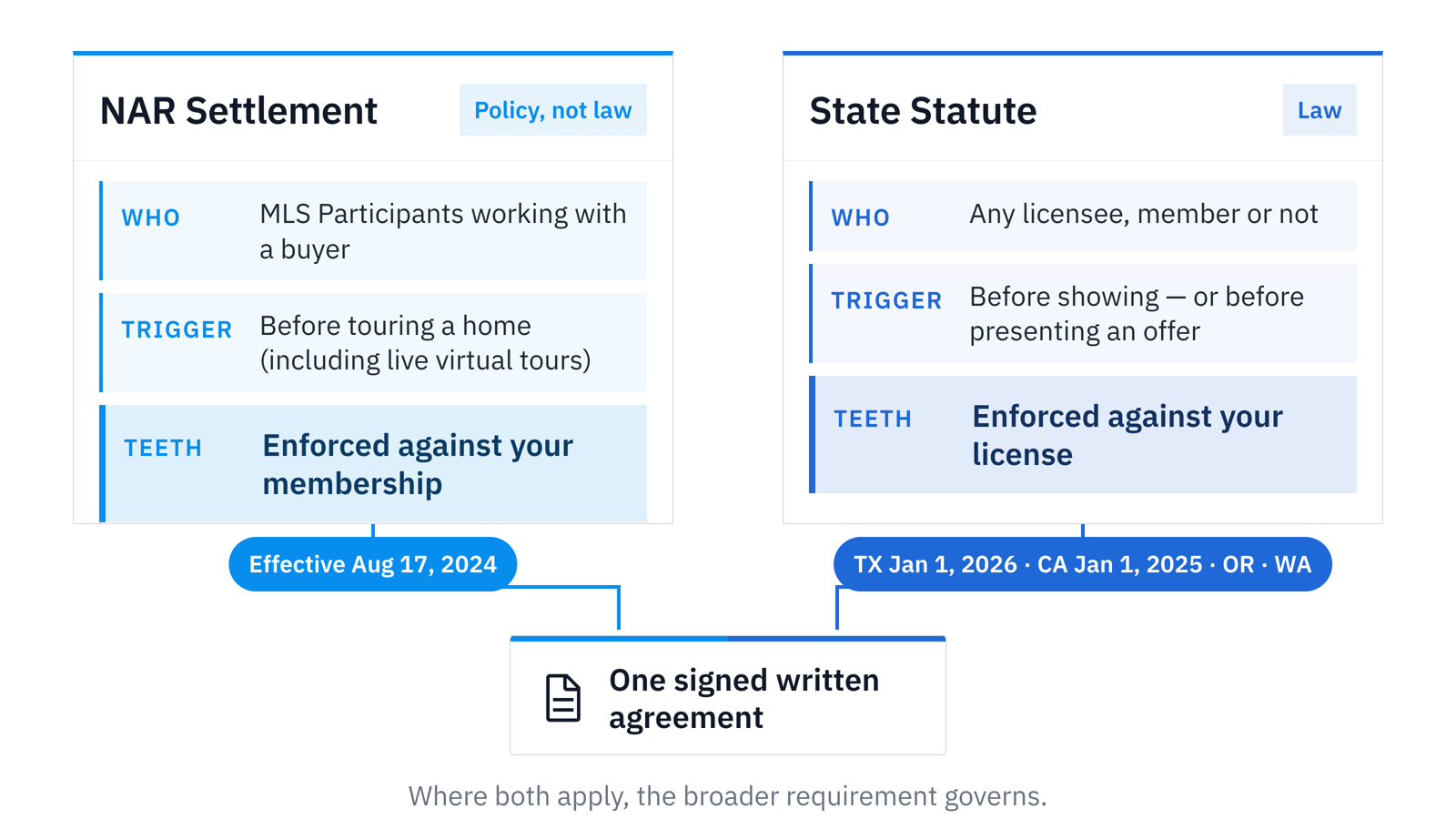
As part of the settlement of the commission litigation, NAR’s practice changes took effect on August 17, 2024. The requirement is narrow in a specific way: it applies to MLS Participants working with a buyer, and it triggers before touring a home — including live virtual tours where the agent walks the property on the buyer’s behalf. It does not trigger on a listing agent’s marketing video, and it doesn’t cover a buyer wandering into a public open house unaccompanied.
Two things follow from this that people miss.
First, it isn’t law. It’s a term of a civil settlement between private parties. As the North Carolina Real Estate Commission put it in its bulletin on the changes, the settlement doesn’t change or override license law or commission rules. A licensee who isn’t a REALTOR® and doesn’t use an MLS was never bound by it at all.
Second, the settlement doesn’t require an agency agreement. It requires a written agreement. Those are different documents with different duties attached, and several states built showing-only forms specifically to fill the gap.
The state law requirements
State statutes are broader, they carry license discipline, and they’ve been stacking since the settlement.
Texas is the sharpest example, and it’s brand new. Section 1101.563 of the Texas Occupations Code took effect January 1, 2026. It requires a license holder working with a prospective buyer of residential property to enter into a written agreement before showing the property — or, if no property will be shown, before presenting an offer on the buyer’s behalf. SB 1968 amended §1101.652 to make failure to do so grounds for disciplinary action, which means TREC can sanction, suspend, or revoke. The old rule was the strange one: before this, a Texas agent working with an unrepresented buyer without an agreement was, by default, a representative of the seller.
Texas also removed two references to subagency from TRELA, narrowing the circumstances in which subagency can arise.
California got there a year earlier. AB 2992 took effect January 1, 2025, and it’s broader than the settlement in scope: it applies to property sales of all types, whether or not the property is on an MLS. The agreement must be signed as soon as practicable and no later than the buyer’s execution of an offer. It also imposes a formatting requirement — a notice that compensation isn’t fixed by law and is negotiable between the parties, in 10-point boldface, immediately preceding any compensation provision. Violating it is treated as a licensing law violation.
Oregon (HB 4058) and Washington (RCW 18.86.020) also require written representation agreements by statute.
Why the distinction matters in practice
Run the four cases:
| NAR member, uses MLS | Not a NAR member | |
|---|---|---|
| State requires it | Bound by both. State law usually broader. | Bound by statute. License at risk. |
| State doesn’t | Bound by settlement policy only. | Not bound — but see the compensation problem below. |
The bottom-right box is the trap. Even where nothing requires the agreement, a broker generally can’t sue for a commission without a signed writing from the party who agreed to pay it. Texas REALTORS® lists that as the first reason to paper the relationship regardless of what’s mandatory. Skipping the agreement isn’t a compliance shortcut; it’s giving up your claim.
What the agreement must contain
Under the settlement’s terms, a written buyer agreement has to do four things:
- Specify and conspicuously disclose the compensation the MLS Participant will receive from any source, or how the amount will be determined.
- Make that amount objectively ascertainable. This is the provision with teeth. Open-ended compensation — whatever the seller happens to be offering — is specifically prohibited. It has to be a number, a percentage, a flat fee, or an hourly rate.
- Cap the total. The agreement must state that the participant may not receive compensation from any source exceeding the amount agreed with the buyer.
- Disclose negotiability in conspicuous language: broker commissions aren’t set by law and are fully negotiable.
Plus any provisions your state requires — which, per the California example above, can include the exact typeface.
Your state or local association’s form already handles all of this. The requirements matter anyway, because they tell you which blanks on the form are load-bearing. The compensation field is not a formality you fill in later.
Exclusive, non-exclusive, and showing-only
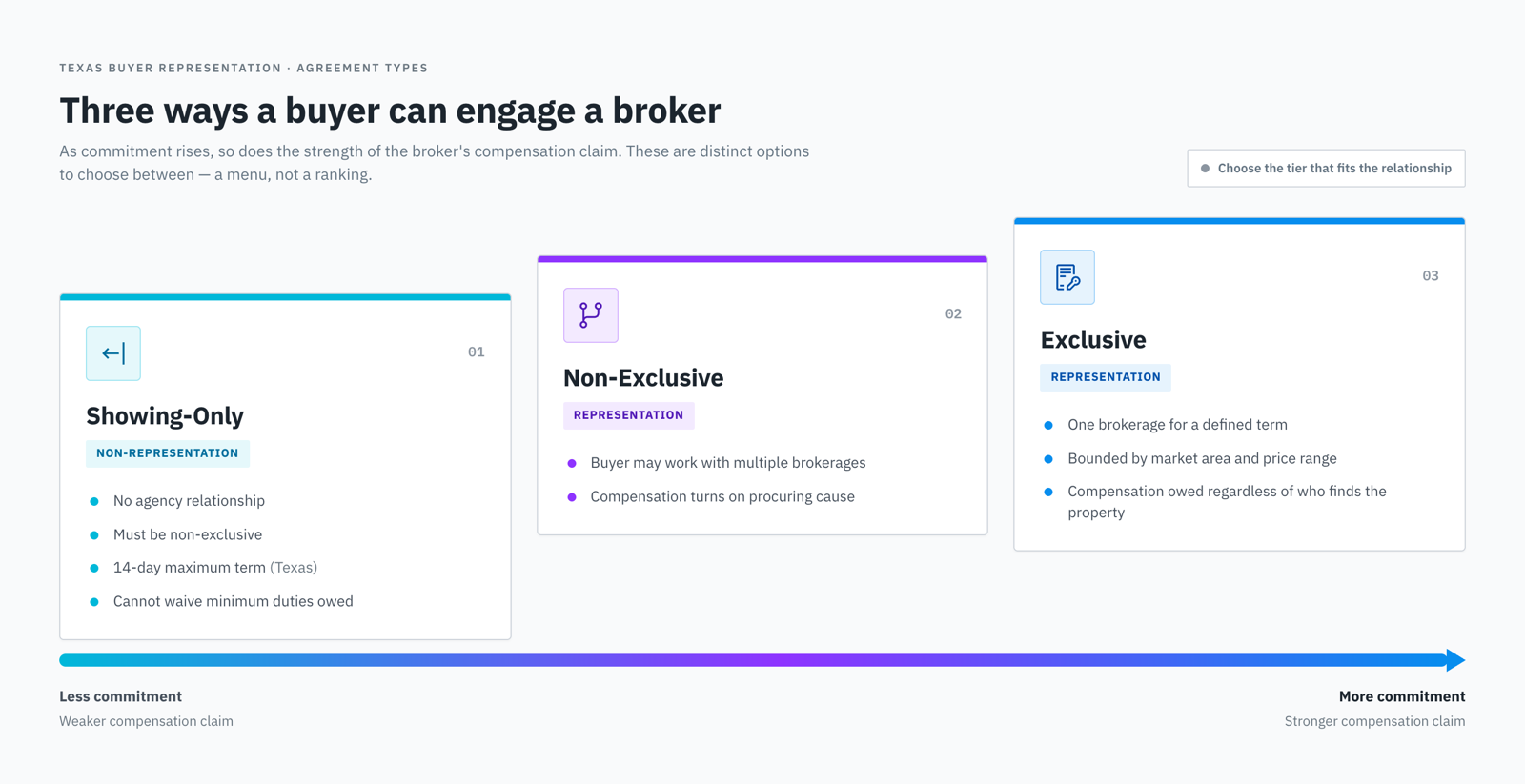
The mandate created demand for a lighter-weight document, and associations answered with a tier structure.
Exclusive. The buyer commits to one brokerage for a defined term, within a defined market area and price range. If the buyer buys inside those boundaries during the term, compensation is owed regardless of who found the property. This is the standard form and the one buyers hesitate over.
Non-exclusive. The buyer can work with multiple brokerages. Compensation typically turns on procuring cause. Lower commitment, weaker claim.
Showing-only / non-representation. No agency relationship — the licensee opens the door and nothing more. Texas permits these under §1101.563, with constraints: they must be non-exclusive, and the termination date can’t exceed 14 days. Florida Realtors® offers a Property Pre-Touring Agreement that delivers the required disclosures and basic compensation information before a showing without establishing representation.
The showing-only tier is the practical answer to “why would I sign something before I’ve even seen a house?” It’s also the tier most likely to be misused. A non-representation agreement can limit services, but it can’t waive the minimum duties a licensee owes a client. If you’re advising on value, recommending terms, or drafting an offer, you’re past the point where a showing-only form covers you.
The clauses that actually bite
The four required provisions get all the attention. These five cause the disputes.
The termination date. Every agreement has one. Almost nobody tracks it. An expired agreement doesn’t stop the buyer from buying — it stops you from having a claim when they do.
Earned versus payable. These are separate events, and the gap between them is where money gets lost. The Texas REALTORS® form is representative: compensation is earned when the client enters into a contract to buy or lease in the market area, or when the client breaches the agreement. It becomes payable later — at closing, or on breach, or when the term runs. A commission can be fully earned on a deal that never closes. Read your form’s language on both.
The protection period. After the agreement terminates, a tail period usually survives it: if the buyer closes on a property you introduced them to during the term, compensation is still owed. The tail is the single most-forgotten obligation in the document, precisely because it activates after everyone has stopped paying attention to the file.
Market area and price range. These define the boundary of the exclusive. A buyer who signs an exclusive for a $400–600K search in one county and then closes on a $900K property two counties over may be outside it entirely. Fill these fields deliberately.
The exit clause. The buyer stays financially responsible for compensating their agent unless the agreement contains an exit provision or the broker releases them. California’s DRE flagged this specifically in its consumer alert. If your buyer wants the freedom to walk from a property where the seller won’t contribute, that freedom has to be written down.
What the agreement creates after it’s signed
Here’s the part that isn’t a document problem. It’s a tracking problem.
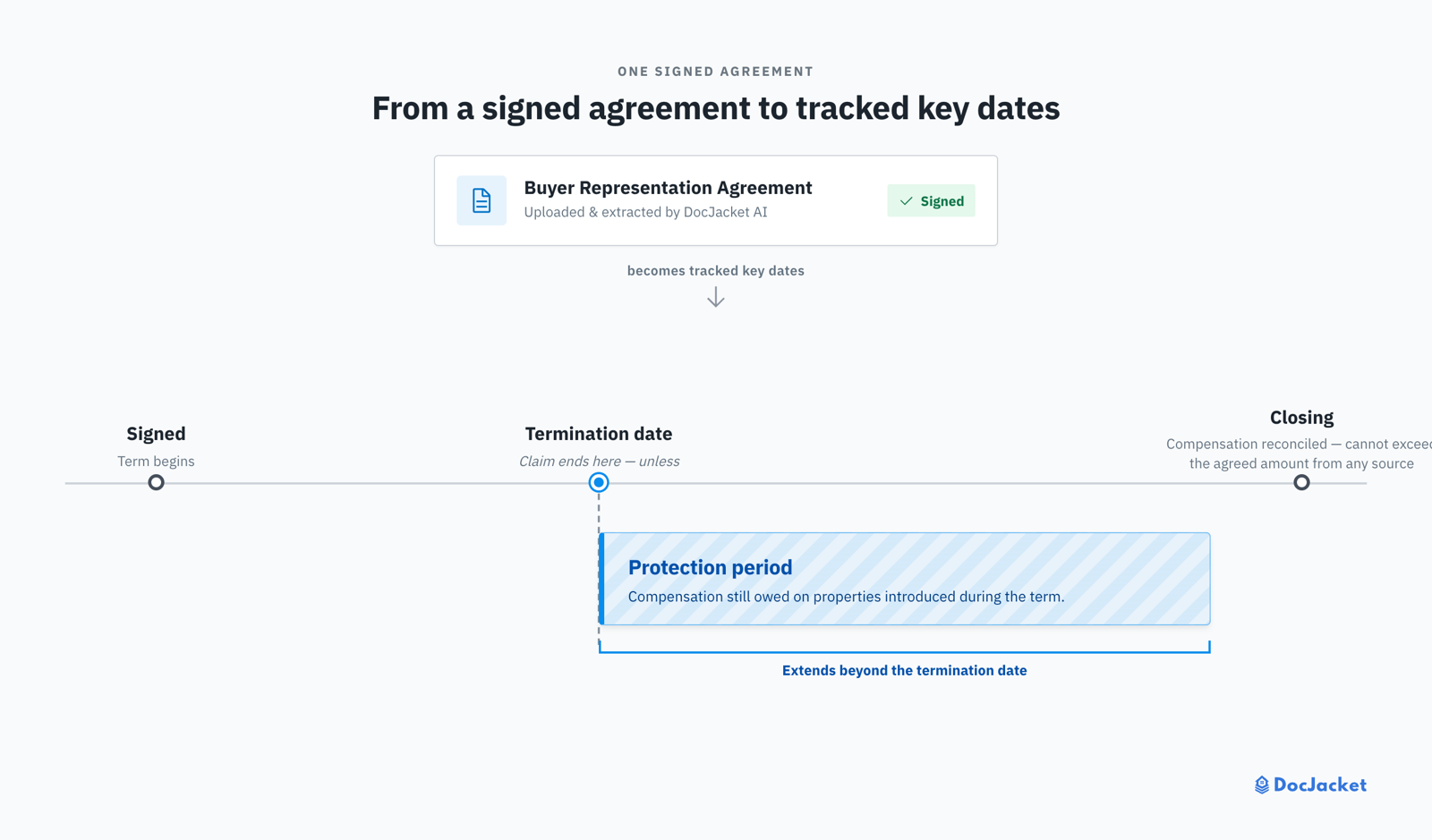
A signed buyer representation agreement isn’t a form you file. It’s a set of live obligations with dates attached:
- A termination date that determines whether you have a claim at all
- A protection period that starts when the agreement ends and runs past it
- A compensation figure that has to be reconciled against the closing statement, because you can’t collect more than it from any source
- A boundary — market area and price range — that determines whether a given property is even inside the deal
- A disclosure record that has to be producible if anyone asks
Multiply that by an active pipeline. A transaction coordinator running 30 files is carrying 30 termination dates, 30 protection-period tails, and 30 compensation figures that need to survive to a closing statement six weeks out. Those dates live in a PDF in a folder, and the folder doesn’t send reminders.
This is what DocJacket does with them. When a buyer representation agreement goes into a transaction, its dates become tracked key dates on the file — the termination date, the protection-period tail, the compensation figure carried through to reconciliation — with the same cadence and the same alerts as an inspection deadline or a financing contingency. The agreement stops being a document and starts being part of the timeline.
See how DocJacket tracks transaction key dates →
Frequently asked questions
Can a buyer refuse to sign? Yes — and then you can’t tour with them. In Texas, if a buyer refuses at an open house, the agent can’t show the property. Refusal is the buyer’s right; showing anyway is your license.
How long does a buyer representation agreement last? Whatever the term says. It’s negotiable, and it’s one of the terms NAR explicitly encourages buyers to negotiate. Showing-only agreements in Texas cap at 14 days. Full representation terms vary widely by state and brokerage.
How do I terminate one? Per the termination provisions in the document. Most forms allow mutual release; some allow unilateral termination with notice. Note that terminating the agreement does not necessarily terminate the protection period.
Do I need one for an open house? Not for a buyer attending unaccompanied. The moment you’re acting on their behalf — advising, negotiating, drafting — you do.
What if the seller won’t cover the compensation? That’s exactly the scenario the compensation and exit clauses are for. The buyer owes the agreed amount unless the agreement says otherwise or you release them. Anything the seller or listing broker contributes reduces what the buyer owes — it doesn’t stack on top of it.
Is a buyer representation agreement required by law? In some states, yes — Texas, California, Oregon, and Washington among them, with more each session. Everywhere else, it’s required by NAR policy for MLS Participants, which is enforceable against your membership rather than your license. Check your state commission.
Where it’s required by statute
The NAR requirement applies to MLS Participants nationwide. These states require a written agreement independently, by law — broader in scope, and enforced against your license rather than your membership.
| State | Authority | Trigger point | Effective |
|---|---|---|---|
| Texas | Occupations Code §1101.563 | Before showing residential property, or before presenting an offer if none is shown | Jan 1, 2026 |
| California | AB 2992 | As soon as practicable, no later than the buyer’s execution of an offer | Jan 1, 2025 |
| Oregon | HB 4058 | Written representation agreement required | Jan 1, 2025 |
| Washington | RCW 18.86.020 | Written brokerage agreement required | Pre-existing |
| Everywhere else | NAR settlement policy | Before touring a home, including live virtual tours | Aug 17, 2024 |
More states take this up each legislative session. Confirm current requirements with your state commission before relying on the table.
Sources
- National Association of REALTORS®, Consumer Guide to Written Buyer Agreements
- National Association of REALTORS®, Written Buyer Agreements 101
- Texas Real Estate Commission, What Changes in 2026 About Buyer/Tenant Representation in Texas
- Texas REALTORS®, Buyer’s Representation legal FAQ
- California Department of Real Estate, Consumer Alert: Changes to Buyer Representation and Compensation
- Brownstein Hyatt Farber Schreck, California’s New Requirements for Buyer-Broker Representation Agreements
- North Carolina Real Estate Commission, Has the World Exploded? The NAR Settlement, Commission Law and Rules
- Florida Realtors®, NAR Settlement FAQs
- Tanya J. Monestier, University at Buffalo School of Law, Report on Buyer Representation Agreements