The short answer at a glance
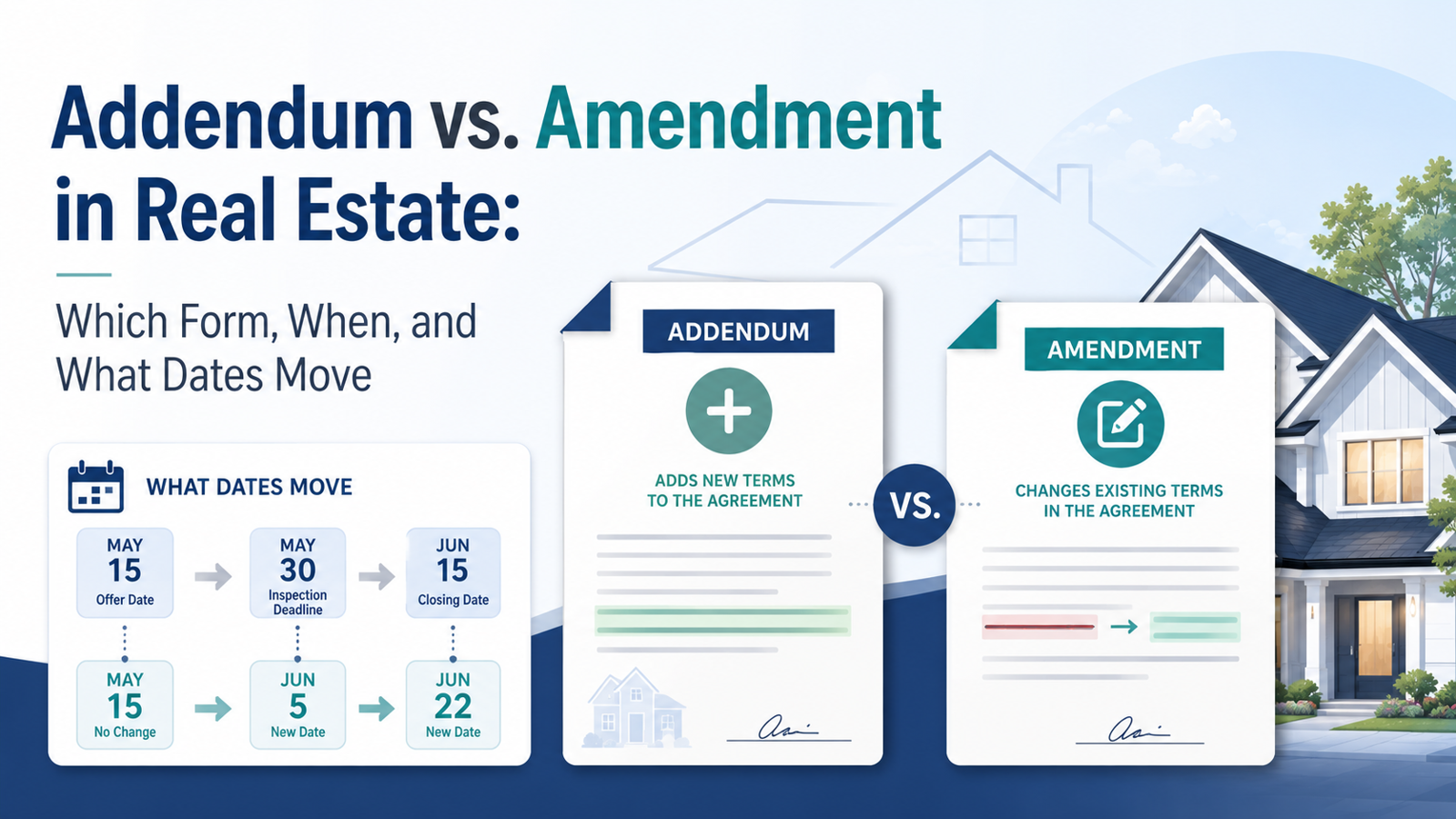
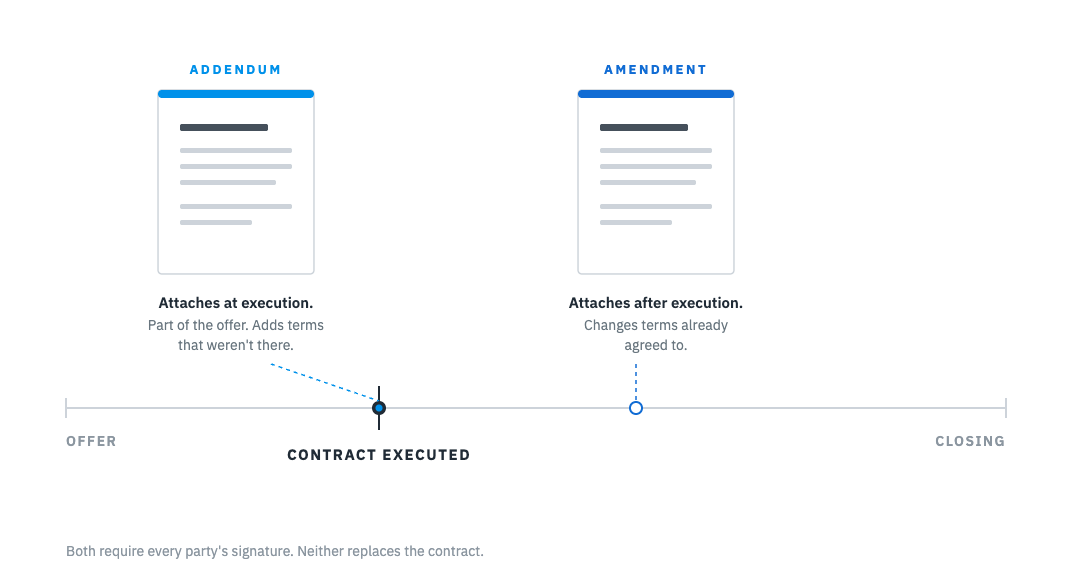
An addendum is attached at contract execution and forms part of the offer. An amendment changes terms after the contract is executed. Both need every party’s signature. But the labels vary by state — what governs is which form your state promulgates for the action you’re taking, and which deadlines that form resets.
| Addendum | Amendment | |
|---|---|---|
| When it attaches | At execution — part of the offer | After execution — changes a live contract |
| What it does | Adds terms that weren’t there | Changes terms already agreed to |
| Typical examples | Third-party financing, lead-based paint, back-up contract, condo/HOA riders | Price reduction, closing date extension, repair credit, option period extension |
| Signatures | All parties | All parties |
| Texas form | Numbered TREC addenda (11-9, 40-11, etc.) | TREC 39-11, Amendment to Contract |
| California form | C.A.R. Form ADM | C.A.R. Form AEA |
| Florida form | FR/BAR riders (CR-7 series), checked into ¶19 | No universal form — varies |
| Common failure | Custom-drafted language creating UPL exposure | Signed correctly, deadlines never updated |
This guide is for transaction coordinators, agents, and brokers working inside promulgated state forms. If you’re trying to understand the closing timeline more broadly, start with our attorney vs. title states breakdown — the answer to “who drafts this?” changes by state too.
Search “addendum vs amendment” and you’ll get a tidy answer within three seconds: addendum adds, amendment alters. Every result says it. It’s clean, it’s memorable, and it will hold up right until you open the actual form.
Because the forms don’t say that. Not in California, not in Florida, and not consistently anywhere else. The document your state’s association promulgated to amend a contract may describe itself as an addendum in its own acceptance paragraph. The rider you attach at execution may describe its own purpose as amending the contract it’s stapled to.
This is not a gotcha. It’s the actual working condition of the job, and it’s why the vocabulary question is the wrong question. Here’s the right one — and the part that actually costs money when you get it wrong.
Why the Clean Definition Falls Apart
Three examples, all from primary sources, all contradicting the rule that every article on this topic repeats.
1. The amendment form that calls itself an addendum
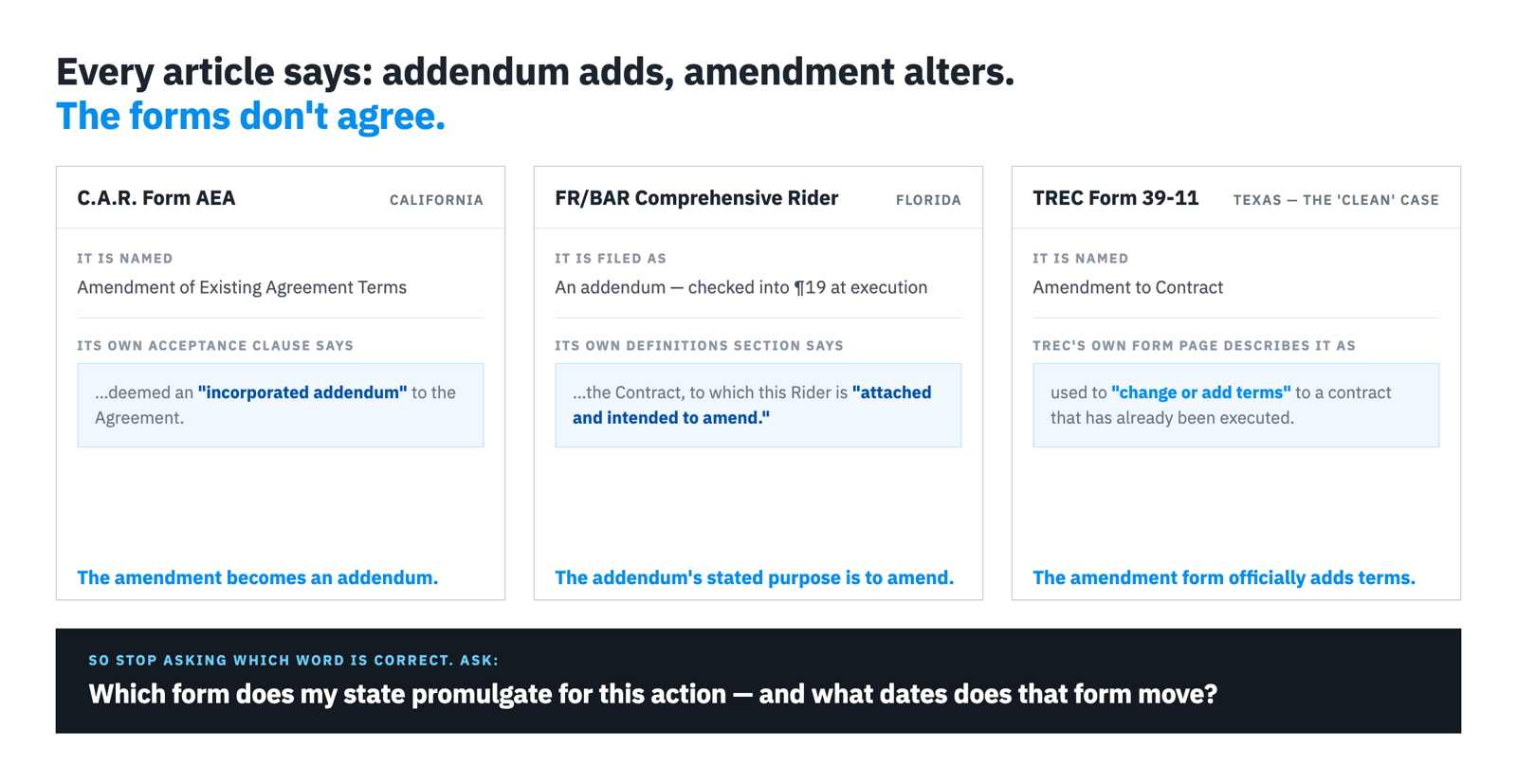
The California Association of REALTORS® publishes Form AEA — Amendment of Existing Agreement Terms. It is, by name and by design, the amendment form. Its acceptance paragraph states that upon acceptance, the Amendment is deemed an “incorporated addendum” to the Agreement.
The amendment becomes an addendum. In the amendment form. In writing.
2. The addendum that says it amends
Florida’s Comprehensive Rider to the FR/BAR Contract for Sale and Purchase is attached at execution and checked into the Addenda paragraph. Its own definitions section describes the Contract as the document to which the Rider is “attached and intended to amend.”
An addendum. Whose stated purpose is to amend.
3. The vendor that contradicts itself
Adobe ranks in the top five for this exact search with a page arguing the standard addendum-adds/amendment-alters line. Adobe’s other page on the same topic defines an addendum as a post-contract attachment that “modifies, alters, or changes” terms of a previously established contract — which is that same page’s definition of an amendment.
Two definitions, opposite meanings, one vendor, both live.
None of this is sloppiness. It’s what happens when a term of art gets used for eighty years across fifty states by three professions with different training. The general-purpose contract world settled on a distinction. Real estate’s promulgated forms never fully did.
So stop asking which word is correct. Ask this instead:
Which form does my state promulgate for the action I’m taking — and what dates does that form move?
That question has a real answer. The vocabulary question doesn’t.
What Your State’s Forms Actually Say
Three states, three completely different resolutions to the same problem.
Texas: TREC Settles It by Form
Texas is the cleanest case in the country, because the Texas Real Estate Commission removed the ambiguity by promulgating separate documents and making them mandatory.
Addenda are numbered, attached at execution, and part of the offer. Third-Party Financing. Sale of Other Property by Buyer. Back-Up Contract. Lead-Based Paint. Coastal Area Property. Propane Gas System Service Area. If a situation is common enough, TREC has a form for it.
One universal amendment handles everything after execution: TREC 39-11, Amendment to Contract. Sales price, closing date, repairs, closing cost allocation, lender-required repairs, financing approval deadlines, option period extensions. One form, all post-execution changes, all parties sign.
Three things Texas practitioners need to know right now:
39-11 went mandatory July 1, 2026. It replaces 39-10. The change is formatting — no substantive provisions differ — but a contract written on a superseded version after the mandatory date is noncompliant. If your saved templates still say 39-10, that’s a five-minute fix you should make today. This shipped alongside new versions of all six promulgated contracts, including the resale contract moving from 20-18 to 20-19.
Version-matching on amendments is a broker protocol question. An amendment to a contract originally written on 20-18 is generally handled on 39-10 to match the version it’s amending. Some brokerages have moved everything to 39-11 by agreement of the parties. This is not a place to freelance — ask your broker.
A blank option fee can void the extension. Extending the termination option requires an amount the buyer has actually paid the seller for the additional option period. Leaving that field blank, or writing $0, may render the amendment unenforceable — which means the option period your buyer thinks they bought does not exist. Texas REALTORS® flags this explicitly.
And the document that isn’t either one: the Notice of Buyer’s Termination of Contract (TREC 38-8) is a one-way notice, not a negotiated change. The buyer exercises a right the contract already granted — during the option period, or on financing approval failure. It needs no counter-signature. Sending an amendment when the contract calls for a notice means asking the other side for permission you didn’t need, and handing them a negotiation you’d already won.
Florida: Riders, Addenda, and a UPL Trap
Florida uses riders, not addenda, as its primary vocabulary — and then also has addenda, which are different, and belong to a different contract.
The Comprehensive Rider to the FR/BAR Contract (CR-7 series) carries the optional clauses: condominium, HOA, FHA/VA, financing terms, inspections. You check the ones you want into the contract’s Addenda paragraph at execution. The Florida Realtors Condominium Addendum (CRSP17x) does similar work for the CRSP contract, which is a different form with different dispute resolution.
The condo review clock is the one that bites. Following the change to §718.503, Florida Statutes, a buyer’s right to review association documents runs seven days, excluding weekends and holidays — and the buyer’s cancellation right may not begin until those documents are actually delivered. Which means the deadline isn’t calculable from the effective date. It’s calculable from a delivery event that may not have happened yet.
Florida’s UPL exposure is real and specific. Adding custom language to the “additional terms” section of an FR/BAR contract, or drafting a standalone addendum, is drafting a legal provision. That’s the unlicensed practice of law if you’re not an attorney. Florida Realtors’ guidance is unambiguous: use the form addendum, or bring in a real estate attorney. If no form addendum covers your situation, that is not an invitation to write one — it’s a signal to make a phone call.
California: Two Forms, and One of Them Expires
California had one form for everything — C.A.R. Form ADM (Addendum) — and used it for price reductions, credits, disclosure supplements, clerical corrections, and anything else that needed writing space. It worked, in the sense that people used it.
It didn’t work in the sense that mattered. ADM was not built to carry the legal weight of contractual changes. So in 2017 C.A.R. published Form AEA — Amendment of Existing Agreement Terms — for contractual changes specifically, leaving ADM for everything else.
Here’s the part almost nobody covers: an AEA has an expiration date.
The AEA is a proposal, not a change. It behaves like a counter-offer. It’s revocable at any time before acceptance, and — this is the important bit — it is deemed revoked if not accepted by 5 p.m. on the third day after the initiating party signed it, unless the parties write in a different date and time. There are separate accept and reject sections. Reject it, and the existing contract stands unchanged.
So in California, an amendment can quietly die of old age. The TC sends it Friday, everyone’s busy, Monday comes and goes, and by 5 p.m. Tuesday the proposal is gone — while both agents believe the closing date moved. That’s a deadline living inside the deadline-changing document, and it doesn’t fire an alert unless something is watching it.
(Form revisions change. Verify the current AEA revision’s acceptance window before relying on the three-day default.)
| Texas | Florida | California | |
|---|---|---|---|
| Adds terms at execution | Numbered TREC addenda | FR/BAR riders (CR-7), ¶19 | Form ADM |
| Changes terms after execution | TREC 39-11 | Varies — no universal form | Form AEA |
| Mandatory forms? | Yes, where promulgated | Approved, widely standard | Approved, not mandatory |
| Custom drafting | Special Provisions = UPL risk | Additional terms = UPL risk | Broker/attorney guidance |
| The trap | Blank option fee voids extension | Condo clock starts on delivery | Amendment expires in 3 days |
The Question That Actually Matters: What Dates Just Moved
Here’s the thing the definitions pages never get to.
An addendum at execution sets the schedule. An amendment mid-deal re-anchors it. And the re-anchoring is where deals actually break — not in the vocabulary.
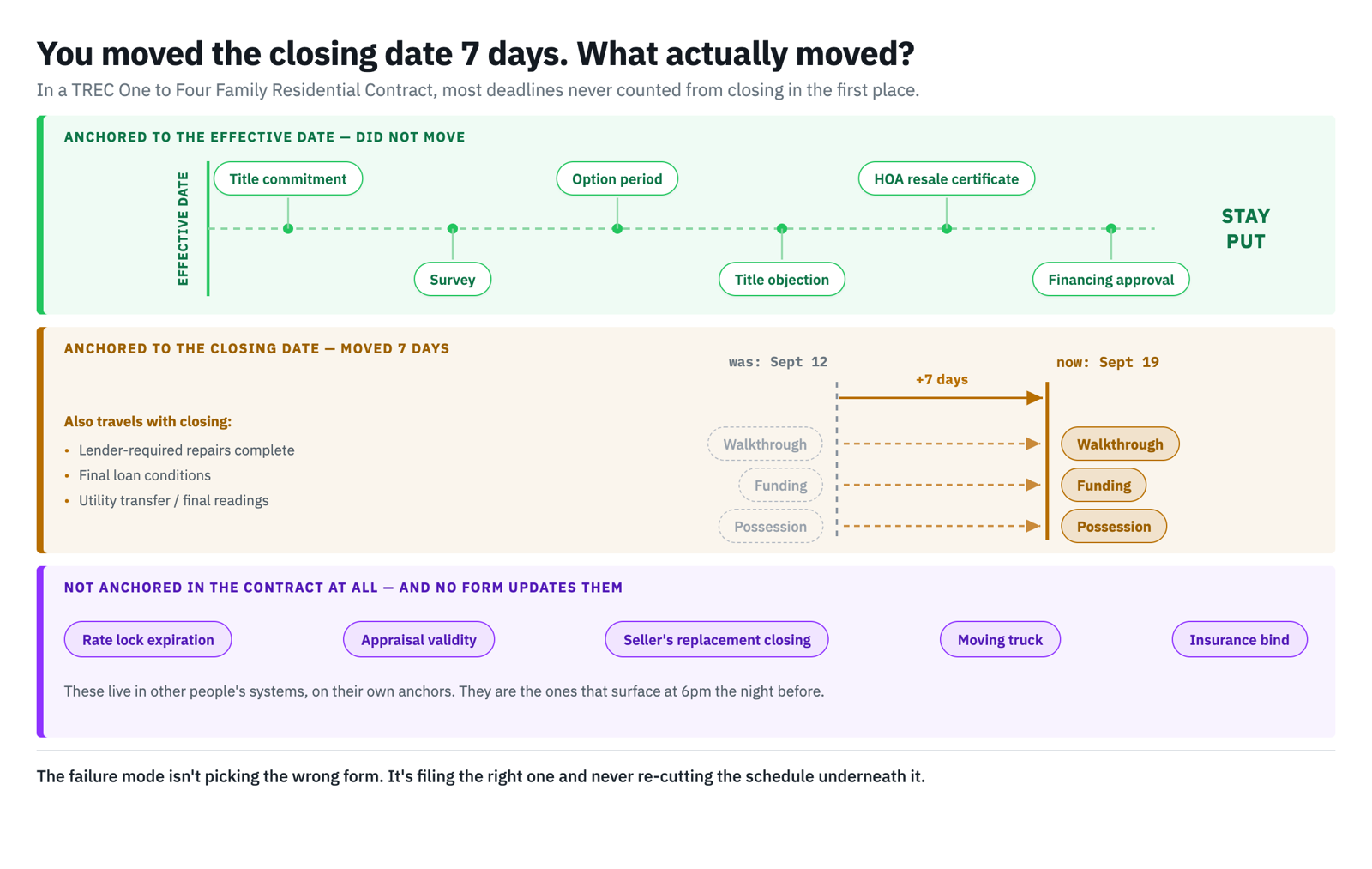
Move a closing date seven days and you have not moved one date. You’ve moved a set. But not the set most people assume, and this is where experience separates from instinct.
Most contract deadlines anchor to the effective date, not the closing date. In a TREC One to Four Family Residential Contract, the title commitment window, the survey deadline, the objection period, the HOA resale certificate, and the option period all count forward from the effective date. Push closing back a week and none of them move. They were never tied to closing.
What does move: the walkthrough, funding, possession, lender-required repair completion, and the buyer’s final loan conditions. Those hang off closing, so they travel with it.
What moves but isn’t in the contract at all: the rate lock. The appraisal validity window. The seller’s replacement-property closing. The moving truck. These have their own anchors, in other people’s systems, and no form updates them.
So the failure mode isn’t picking the wrong word. It’s this:
You pick the right form. You fill it out correctly. Everyone signs. And four other dates silently became wrong, in three different systems, and nobody notices until the lender calls.
The reverse case is worse and rarer. When a back-up contract moves into first position, the effective date itself changes — and the effective date is the anchor for nearly everything. That single event re-cuts the entire schedule. Every deadline in the deal recalculates from a new zero.
This is the actual work of coordination. Not knowing that an amendment alters and an addendum adds. Knowing that this amendment, on this form, in this state, just moved these six dates and left those five alone — and getting the corrected schedule in front of the agent, the client, the lender, and title before anyone acts on the old one.
DocJacket exists for that specific moment. The amendment goes in. The dates re-anchor themselves. Everyone on the deal sees the new schedule before you’ve closed the tab. No re-typing, no spreadsheet surgery, no 9 p.m. discovery that the financing deadline was never updated.
Which One Do I Use? A Decision Tree
-
Has the contract been executed? No → addendum, attached to the offer. Yes → keep going.
-
Are you exercising a right the contract already gives you? Termination during the option period. Financing approval failure. → Neither. That’s a notice. One-way, no counter-signature, don’t negotiate what you already own.
-
Are you changing a term that’s already in writing? Price, closing date, repairs, deadlines → amendment. TREC 39-11. C.A.R. AEA. Your state’s equivalent.
-
Are you adding something that isn’t there and doesn’t touch an existing term? → addendum — but check whether your state already promulgates a form for it. It usually does.
-
Does no promulgated form cover it? → Attorney. Especially in Florida. This is not a writing prompt.
-
Whatever you filed — what dates just changed? Answer this before you send the email. Every time.
Common Mistakes
Using an amendment where the contract calls for a notice. You had a unilateral right. You just converted it into a negotiation.
Blank or $0 option fee on a Texas amendment. The extension may be unenforceable. Your buyer is operating on an option period that doesn’t legally exist.
Letting a California AEA lapse. 5 p.m. on day three, and the amendment everyone believes is in place was revoked by operation of the form.
Custom-drafting addendum language in Florida. UPL. Use the form or call an attorney.
Running 39-10 templates after July 1, 2026. Noncompliant. Update the template.
Assuming a closing extension moves everything. In TREC contracts, most deadlines anchor to the effective date. They didn’t move. Check.
Signing the amendment and never updating the schedule. This is the one that actually kills deals, and it’s the one nobody writes an article about.
Frequently Asked Questions
What is an addendum in real estate?
An addendum is a document attached to a purchase contract at execution that adds terms not covered in the base form — financing type, lead-based paint disclosure, HOA documents, a back-up position. It’s part of the offer, and every party signs. Most states promulgate standard addenda for common situations rather than expecting agents to draft them.
What is the difference between an addendum and an amendment?
An addendum attaches at execution and adds new terms. An amendment comes after execution and changes terms already agreed to. Both require all parties’ signatures and neither replaces the original contract. In practice, which document you use is decided by your state’s promulgated forms, not by the definitions — and the forms are not always consistent with them.
Can you add an addendum after a contract is signed?
Generally no — that’s what an amendment is for. Some state forms blur this (C.A.R.'s AEA becomes an incorporated addendum on acceptance), and some brokerages use “addendum” loosely for post-execution changes. Use the form your state promulgates for the action you’re taking, and let the label follow the form.
Does an addendum need to be signed by all parties?
Yes. Both addenda and amendments require signatures from every party to the contract. A one-sided document that changes contract terms isn’t an addendum or an amendment — it’s a proposal. The exception is a notice, which exercises a right the contract already granted and is one-way by design.
Is a rider the same as an addendum?
Functionally, usually yes — Florida’s FR/BAR uses “rider” for what Texas calls an addendum. Both attach at execution and become part of the contract. The terminology is regional. What matters is whether it’s checked into the contract’s Addenda paragraph and signed.
Does an amendment replace the original contract?
No. It changes the specific terms it names and leaves everything else intact. The original contract remains the governing document, and the amendment becomes part of it. This is why a stack of four amendments is still one contract — and why reconstructing the current deadline schedule from that stack is the job.
What’s the plural of addendum?
Addenda. “Addendums” is common in practice and understood everywhere, but promulgated forms and contract paragraphs use addenda.
Conclusion: The Word Is Not the Work
Every article on this topic stops at the definition. The definition is the easy part — and, as the forms themselves demonstrate, it isn’t even reliably true.
The work is downstream. Pick the form your state promulgates for the action you’re taking. Get every signature. Then answer the question that actually determines whether the deal closes on time: what dates just moved, what dates didn’t, and who still thinks the old schedule is live?
That’s the difference between filing paperwork and coordinating a transaction. It’s also, not coincidentally, the difference between a document storage tool and a transaction coordinator platform.
Working the deadline side of this? Our earnest money calculator and TC email templates cover the two things that break most often after an amendment posts.
This article is general information for real estate professionals, not legal advice. Form versions, statutes, and mandatory-use dates change — verify current forms with your state commission or association, and follow your broker’s protocol. For anything requiring drafted language, consult a real estate attorney.
Sources: Texas Real Estate Commission contract forms; 22 Tex. Admin. Code §537.46; Texas REALTORS® legal FAQ and forms updates; C.A.R. Form AEA and Form ADM; Florida Realtors form descriptions and FR/BAR Comprehensive Rider; §718.503, Fla. Stat. Last verified July 2026.