Escalation Clause in Real Estate
How an escalation clause works — base, increment, and cap — and how to use one without overpaying in a multiple-offer situation.

An escalation clauseis a provision a buyer adds to a real estate purchase offer that automatically raises their price above a competing offer — by a fixed amount, up to a maximum. In plain terms: "I'll pay $3,000 more than the highest competing offer, but never above $525,000." It lets a buyer stay in the running during a multiple-offer situation without blindly overbidding to guess the winning number.
Every escalation clause is built from three numbers — a base, an increment, and a cap — plus one thing buyers too often skip: a requirement that the seller prove the competing offer that triggered the escalation. This guide walks through all four, with a worked example.

On this page

Quick Definition
An escalation clause automatically increases a buyer's offer to a set amount above the highest bona fide competing offer, up to a maximum price (the cap) the buyer will not exceed.
The clause is a competitive tool, not a valuation tool. It doesn't decide whether the home is worth the money — it keeps a buyer in a bidding war on their own terms, with a ceiling they set in advance. The cap is the buyer's discipline; the increment is how they stay in front.

How the Three Parts Work
Base, increment, cap — plus the proof requirement that protects the buyer.
Base offer price
The starting number — what the buyer offers if no competing offer materializes. The escalation only kicks in above this. A well-written clause always states the base explicitly so nobody argues later about where the ladder starts.
Increment (the beat-by amount)
How much the buyer will beat a competing offer by — e.g. $2,000 over the highest bona fide competing offer. The increment is a fixed step, not a percentage, so the resulting price is always exact and verifiable.
Cap (the ceiling)
The maximum the buyer will pay, no matter how high competing offers climb. Above the cap, the buyer is out. The cap is the single most important number for the buyer — it's their true walk-away price, and it should never be left blank.
Proof requirement
The clause should require the seller to produce the competing offer (or the relevant page of it) that triggered the escalation. Without a proof clause, the buyer is trusting the seller's word on a number that costs them real money. Good clauses name what proof is acceptable.

A Worked Example
The same clause, played out against two different competing offers.
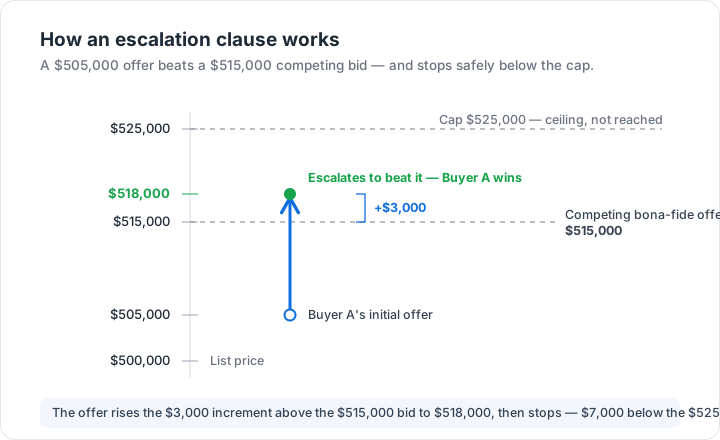
List price: $500,000
The home goes on the market at $500,000 in a market likely to draw multiple offers.
Buyer A's initial offer: $505,000
Buyer A offers $505,000 up front and adds an escalation clause: beat any higher bona fide offer by $3,000, up to a $525,000 cap. If no higher offer ever appears, they simply pay $505,000.
Increment $3,000 · Cap $525,000
The buyer beats a competing offer by $3,000 each time, but never goes above $525,000 — that ceiling is their true walk-away price.
A competing offer arrives at $515,000
The escalation engages: $515,000 + $3,000 = $518,000. Still under the $525,000 cap, so Buyer A wins at $518,000 — $3,000 above the competition and $7,000 below their own maximum. They didn't overpay; they paid exactly enough to win.
The cap case: a competing offer at $524,000
$524,000 + $3,000 = $527,000, which exceeds the $525,000 cap. The clause stops at $525,000; beyond that Buyer A is out and the seller can take the competing offer. Note the escalation never jumps straight to the cap — it's always the competing offer plus the increment.

The Competing-Offer Trigger
An escalation clause only engages when a bona fide competing offer exists — a genuine, arm's-length written offer from another buyer. That trigger is the whole game. Because the competing offer is what raises the buyer's price, the number has to be real and provable, not asserted.
This is also the line good software should never cross. A tool can describe the escalation, calculate the resulting price once a proof-backed competing offer is entered, and flagwhen an escalated price would breach the cap or the appraisal. What it must never do is invent a competing offer or auto-declare a "winning" price without a verified trigger. The arithmetic is deterministic; the trigger is a fact that must be proven. Describe, calculate, flag — never fabricate.
When an escalation is one of several offers on the table, the seller side is really running a comparison — weighing the escalated price against clean offers, terms, and financing. That's the same problem the handling multiple offers on a house guide covers, and it's exactly where an offer-comparison workspace earns its keep.

When to Use One
Confirmed multiple-offer situation
The listing agent has announced a deadline for highest-and-best, or the buyer's agent knows other offers are in. An escalation clause lets the buyer stay competitive without blindly overbidding.
Hot market, fast-moving inventory
In a market where good listings go in days, an escalation clause is a way to say “we're serious and we'll beat the field, up to a point” without the buyer having to guess the winning number.
A home the buyer genuinely does not want to lose
When the buyer's emotional and financial ceiling are both clear, the cap encodes the ceiling and the increment keeps them in the running — a disciplined alternative to “just offer more.”
When the buyer wants a ceiling, not an open checkbook
The whole point is the cap. A buyer who is uncomfortable naming a maximum probably shouldn't use an escalation clause — a plain strong offer may serve them better.

Risks to Watch
You reveal your ceiling to the seller
An escalation clause hands the seller your cap. A savvy seller now knows exactly how high you'll go — and may counter you straight to the cap rather than accept the escalated price. Some buyers' agents prefer a strong clean offer precisely to avoid showing this card.
Weak or missing proof requirements
If the clause doesn't require the seller to prove the competing offer, you're trusting their word on a number that raises your price. Always insist the clause name acceptable proof (a copy of the competing offer with personal details redacted is common).
Appraisal gap
An escalated price can climb above the home's appraised value. If your financing depends on the appraisal, the escalated price can open a gap you have to cover in cash. The cap should be set with the appraisal risk in mind, not just the competition.
Some listing agents reject escalation clauses outright
Certain sellers and agents won't accept escalation clauses at all — they prefer to call for highest-and-best and compare clean numbers. Know the listing agent's stance before you build your strategy around a clause they'll toss.

Frequently Asked Questions
What is an escalation clause in real estate?
An escalation clause is a provision a buyer adds to a purchase offer that automatically raises their price above a competing offer, by a set increment, up to a maximum (the cap). For example: “Buyer will pay $3,000 more than the highest bona fide competing offer, up to a maximum of $525,000.” It lets a buyer stay competitive in a multiple-offer situation without overpaying by guessing the winning number.
How does an escalation clause work?
It has three parts: a base price (the starting offer), an increment (how much the buyer beats a competing offer by), and a cap (the ceiling the buyer won't exceed). When a bona fide competing offer arrives, the buyer's price escalates to that offer plus the increment — unless that would exceed the cap, in which case the price stops at the cap. The seller typically must provide proof of the competing offer that triggered the escalation.
What is a “bona fide competing offer”?
A bona fide competing offer is a genuine, arm's-length written offer from another buyer — not a bluff, a family member's placeholder, or a verbal claim. Because the competing offer is what raises the buyer's price, a well-drafted escalation clause defines what counts as bona fide and requires the seller to produce documentation of it before the escalation applies.
Should the seller have to prove the competing offer?
Yes — this is the single most important protection for the buyer. Without a proof requirement, the buyer is raising their own price on the seller's unverified word. Good escalation clauses require the seller to provide a copy of the competing offer (personal information can be redacted) that triggered the escalation, so the buyer can confirm the number is real.
What are the risks of using an escalation clause?
The main risks are: (1) you reveal your maximum price to the seller, who may simply counter you to your cap; (2) weak proof language lets the seller inflate the trigger; (3) the escalated price can exceed the appraised value, creating a financing gap you cover in cash; and (4) some listing agents reject escalation clauses and prefer clean highest-and-best offers. Set the cap with the appraisal in mind and insist on a proof clause.
Is an escalation clause a good idea?
It depends on the situation. In a confirmed multiple-offer scenario on a home the buyer genuinely wants, an escalation clause is a disciplined way to stay competitive with a built-in ceiling. But if the buyer isn't comfortable revealing their cap, or the listing agent won't accept clauses, a strong clean offer may serve better. It's a tool for a specific moment, not a default.
Can software calculate the winning escalated price for me?
Good offer-management software will describe and lay out the escalation — base, increment, cap, and the arithmetic once a proof-backed competing offer is entered — and flag when an escalated price would breach the cap or the appraisal. What it should never do is invent a competing offer or auto-declare a winning price without a verified trigger. The math is deterministic; the trigger is a fact that has to be proven, not assumed.

Stop tracking offers in email.
DocJacket reads each offer document, lays out escalation terms — base, increment, and cap — and compares every offer side by side so nothing gets missed. See how real estate offer management software handles a multiple-offer situation.
About the author
Casey Spaulding
Casey Spaulding is the founder of DocJacket and a third-generation real estate operator who grew up around his family's independent brokerage. A 21-year U.S. Navy veteran with a background in high-stakes documentation and compliance workflows, and an MS in computer science with an AI specialization, he built DocJacket's offer and transaction tools himself.
Read Casey's full profile →