
Paperless Pipeline is one of the most established names in real estate transaction management. It’s been around since 2009, serves over 80,000 real estate professionals across the U.S. and Canada, and processes nearly 28,000 transactions per month. It’s the platform many brokerages grew up on — reliable, straightforward, and built for compliance.
But “established” cuts both ways. Multiple user reviews describe the interface as “outdated” and “reminds me of 90s Windows.” There’s no AI. Setup is manual. And the production-based pricing that works well for small brokerages can get expensive fast as your volume grows.
DocJacket represents a different generation of TC software. Built from the ground up with AI at the core, it reads your contracts, builds your timelines, drafts your communications, and eliminates the manual data entry that defines legacy platforms. And it starts at $15/user/month — regardless of how many transactions you process.
Let’s see how they stack up.
Quick Comparison
| Feature | DocJacket | Paperless Pipeline |
|---|---|---|
| Founded | 2025 | 2009 |
| Built for | Transaction coordinators | Brokerages and broker admins |
| Pricing model | Flat monthly rate | Production-based (per transaction tier) |
| Starting price | $15/user/month (introductory) / $29/user/month | $65/month (5 transactions) |
| At 25 transactions/month (solo TC) | $15–$29/month | $175/month |
| Additional users | $15 or $29/user/month | Included (unlimited on all plans) |
| AI contract extraction | Yes — 30–45 seconds | No |
| Automated timeline building | Yes — AI-generated from contract data | No — manual date entry with automated calculations |
| Built-in e-signatures | No | Yes — Pipeline eSign |
| Commission management | No | Yes — add-on module ($54–$114+/month) |
| Email templates | Yes, with AI draft assist | Basic notifications |
| SMS messaging | Yes — included natively | No |
| Checklists | Yes | Yes — auto-applied by deal type |
| Document management | Yes | Yes — strong, with unlimited storage |
| Compliance/audit trail | Yes | Yes — strong |
| Mobile app | Web-based | iOS app available |
| Integrations | Gmail, Outlook | DocuSign, ZipForm, 3,000+ via Zapier |
| API | Coming soon | No |
| Free trial | Yes — first transaction free | Yes — 14 days, 9 free transactions |
| Best for | Solo TCs and small teams wanting AI speed | Brokerages needing compliance, commissions, and proven stability |
The Core Difference: Next-Gen AI vs. Proven Legacy
This comparison isn’t about which platform has more features. It’s about two fundamentally different approaches to building transaction management software.
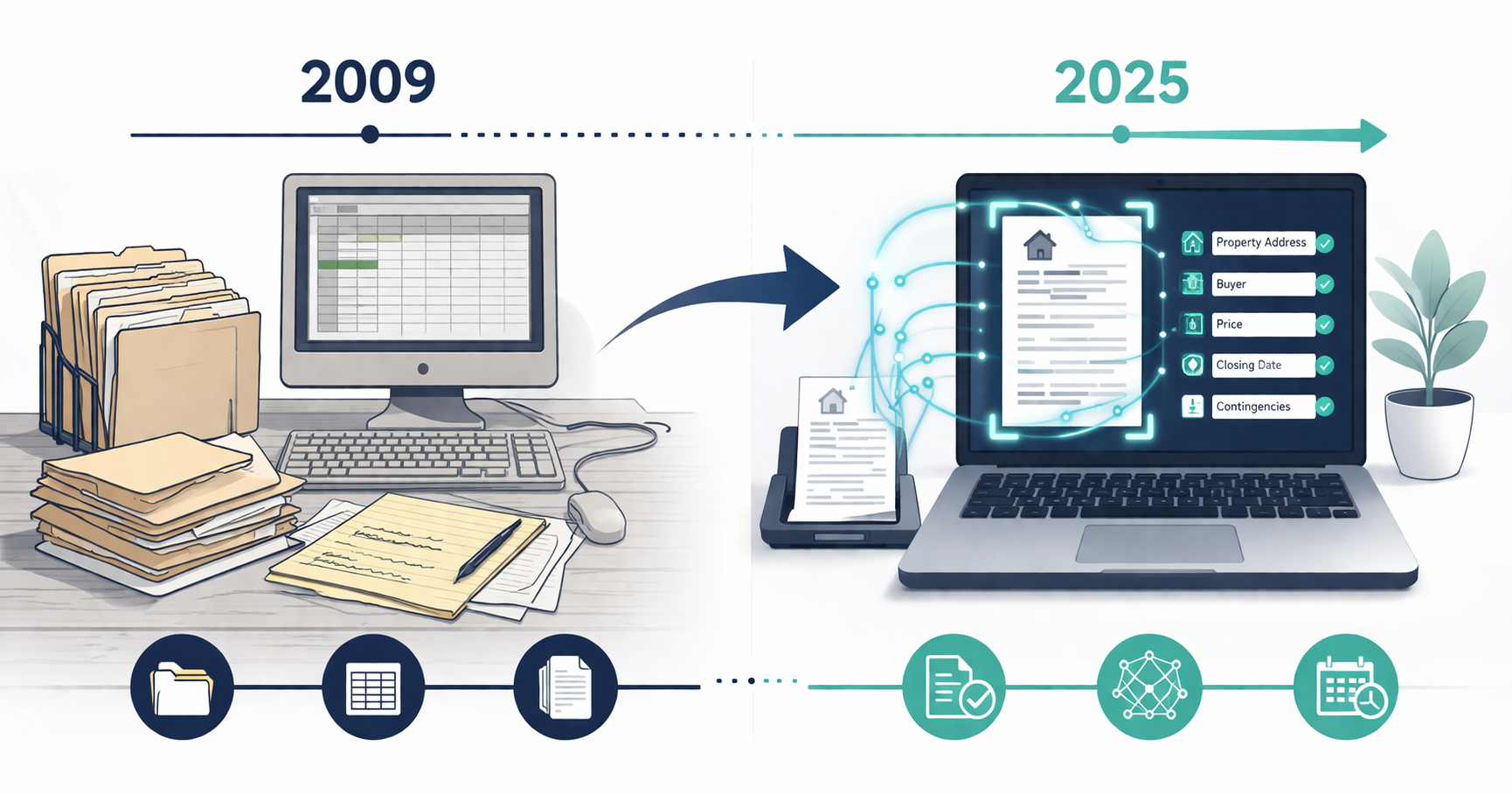
Paperless Pipeline was built in an era when the primary problem was getting real estate paperwork off of physical desks and into the cloud. And it solved that problem well. Document storage, checklists, compliance tracking, and commission management — all the core administrative needs of a brokerage, digitized and centralized. It’s reliable, it works, and thousands of brokerages depend on it daily.
DocJacket was built in an era where the problem isn’t digitization — it’s automation. Documents are already digital. The bottleneck now is the manual work of reading contracts, entering data, building timelines, and tracking deadlines across dozens of simultaneous transactions. AI eliminates that bottleneck.
Where you feel the difference most:
When you open a new transaction in Paperless Pipeline, you manually enter the property address, buyer/seller information, key dates, and transaction details. You select the appropriate checklist template, and the system applies it. You upload documents one by one and track their status.
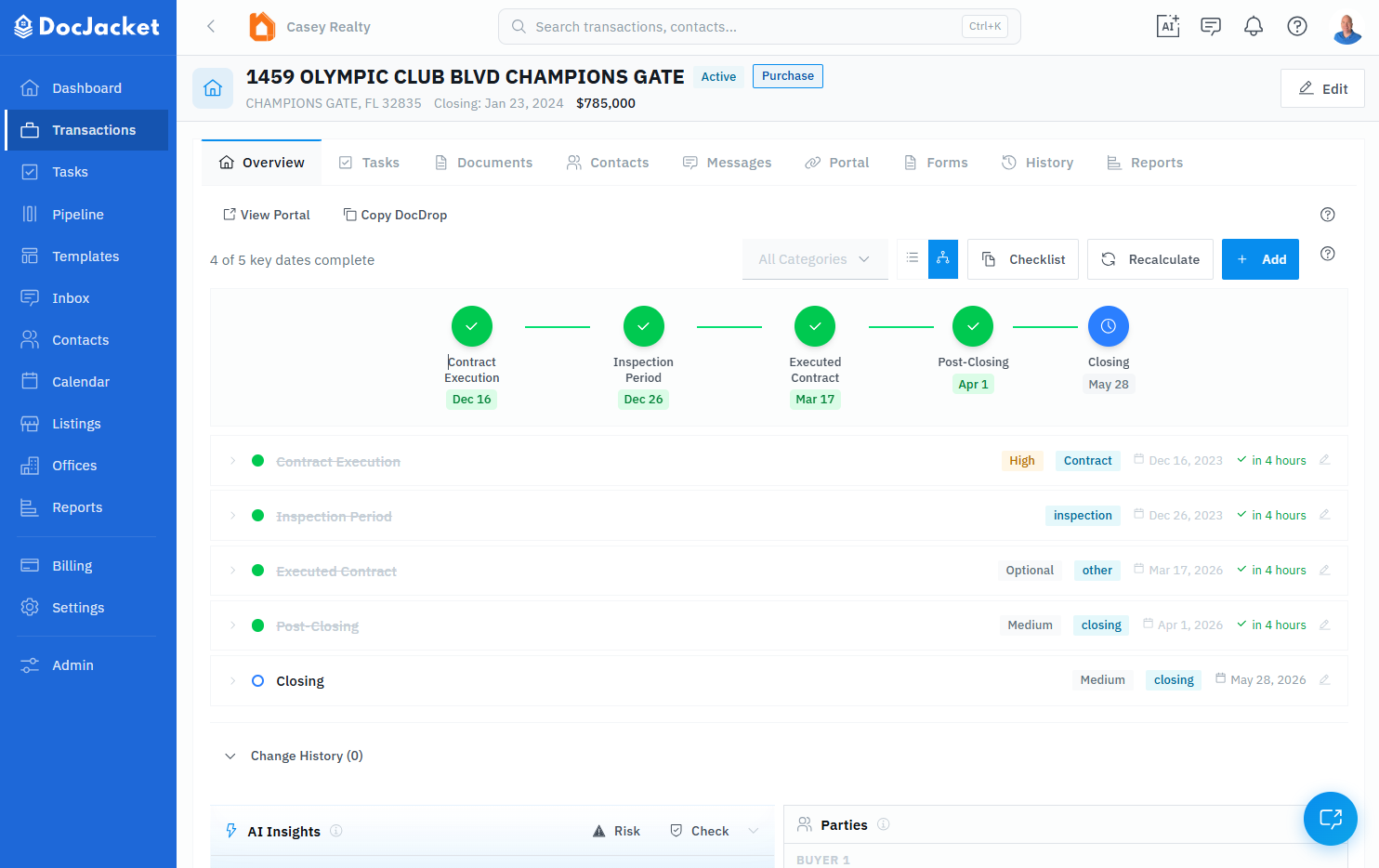
When you open a new transaction in DocJacket, you upload the purchase agreement. AI reads it in 30–45 seconds, extracts all the key data — names, addresses, dates, contingencies, financial terms — and builds your timeline automatically. You review what AI prepared, approve it, and move on.
That’s the difference between a 2009 workflow and a 2026 workflow.
Pricing: Flat Rate vs. Production-Based
This is where the comparison gets interesting, because the pricing models are completely different.
Paperless Pipeline charges based on how many new transactions you start each month:
| Monthly Transactions | Monthly Cost | With Commission Module |
|---|---|---|
| 5 | $65 | $119 |
| 10 | $130 | $184 |
| 25 | $175 | $234 |
| 40 | $220 | $279 |
| 80 | $305 | $414 |
| 150 | $390 | $504 |
| 250 | $495 | $609 |
| 450 (Unlimited) | $675 | $675+ |
The good news: unlimited users on every plan, no setup fees, no annual contracts. The less-good news: your costs rise directly with your success. A TC handling 25 transactions/month pays $175–$234/month. At 80 transactions (a multi-TC team), you’re at $305–$414/month.
DocJacket pricing is flat:
- $15/user/month for the first 100 customers (introductory, locked for life)
- $29/user/month standard pricing
- $25/user/month ($300/user/year) billed annually
- No per-transaction surcharges — flat rate regardless of volume
The math at scale (solo TC):
| Volume | DocJacket (1 user) | Paperless Pipeline | You Save |
|---|---|---|---|
| 10 tx/month | $29 | $130 | $101/month |
| 25 tx/month | $29 | $175 | $146/month |
| 40 tx/month | $29 | $220 | $191/month |
| 80 tx/month | $29 | $305 | $276/month |
At 25 transactions per month, a solo TC on DocJacket saves $1,752 per year compared to Paperless Pipeline’s base plan. For a 2-person team, DocJacket runs $58/month vs. PP’s $175 — still a $117/month savings. Note that Paperless Pipeline includes unlimited users on all plans, so their cost doesn’t increase with team size — only with transaction volume.
When Paperless Pipeline’s pricing makes sense: If you’re a brokerage with 5–10 transactions per month and need commission management, the $119–$184/month range is competitive and includes features DocJacket doesn’t have. The production-based model also means you pay less during slow months.
When DocJacket’s pricing wins: If you’re a growing TC or team where transaction volume is climbing, flat-rate pricing means your costs don’t rise with your success. The more you grow, the better DocJacket’s value gets relative to production-based pricing.
AI and Automation: The Generational Gap
This is the largest feature gap between the two platforms.
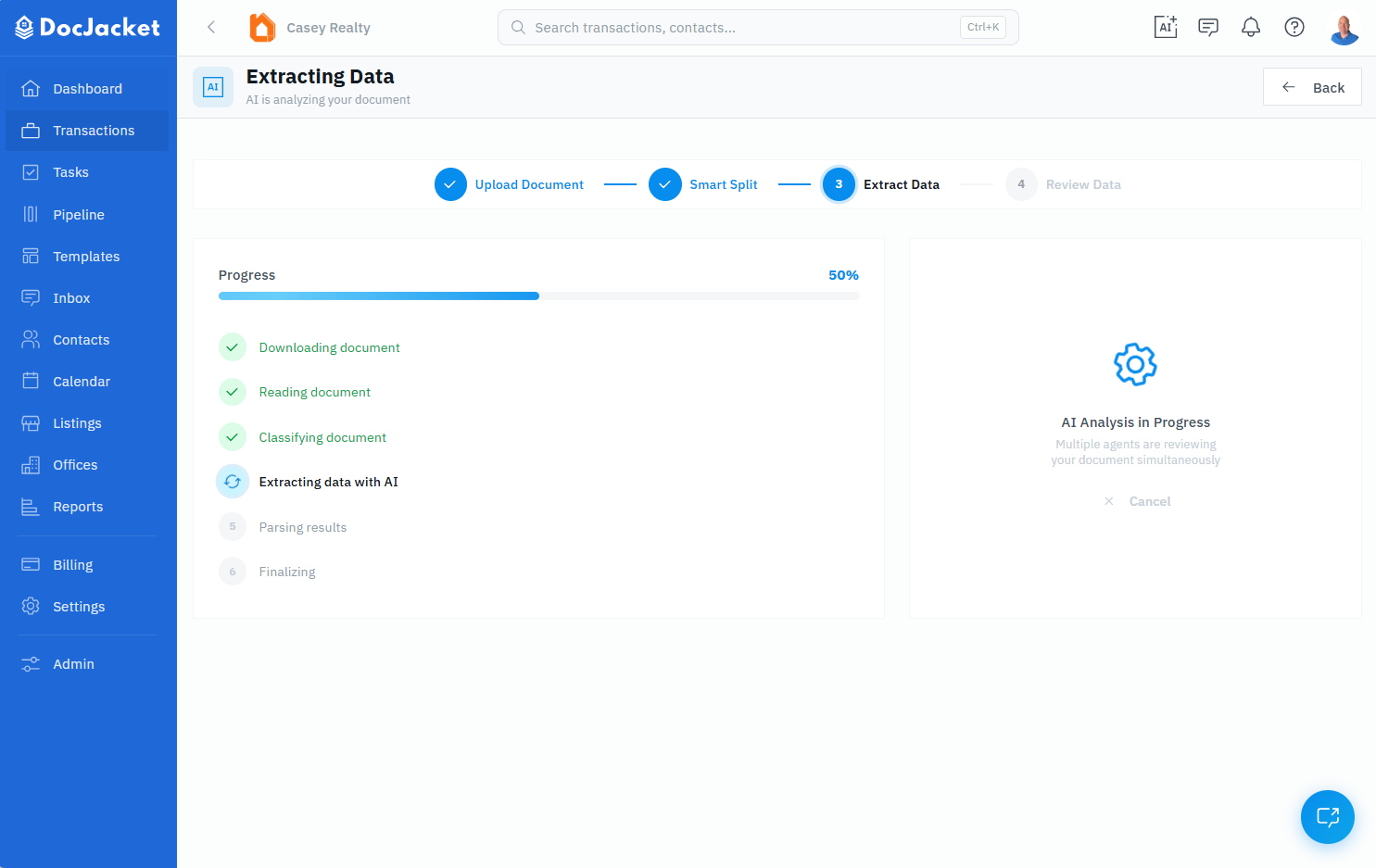
DocJacket’s AI capabilities:
- Contract extraction — upload a purchase agreement and AI reads it in 30–45 seconds, extracting buyer/seller info, property details, key dates, contingencies, and financial terms
- Automated timeline building — deadlines calculated and a full transaction timeline generated automatically
- AI email drafting — contextual communications drafted based on transaction status and phase
- Document intelligence — AI categorizes, organizes, and flags compliance issues
Paperless Pipeline’s automation:
- Auto-applied checklists by deal type
- Automated date calculations from key dates
- Task assignments and due date notifications
- Commission calculations
- No AI contract reading or data extraction
- No automated timeline generation
- No AI-powered communication
Paperless Pipeline has published an AI roadmap signaling they’re planning to add AI features. But as of early 2026, nothing has shipped. Today, every new transaction in Paperless Pipeline requires manual data entry to get started.
For a TC managing 20+ files per month, the time savings from AI extraction alone — roughly 25 minutes per transaction — adds up to 8+ hours per month. That’s an entire workday you get back.
Commission Management: Where Paperless Pipeline Excels
If commission management is a core part of your workflow, Paperless Pipeline has a clear advantage.
Paperless Pipeline’s Commission Module (add-on pricing) includes:
- Automated commission calculations with customizable split structures
- Instant commission statements for agents
- Commission Disbursement Authorizations (CDAs) — praised by users as one of the platform’s best features
- PDF and spreadsheet financial reports
- Automated production emails with monthly and year-to-date figures
- Agent-facing visibility into their own financial production data
DocJacket does not include commission management. If calculating and tracking commissions is a significant part of your role, you’d need a separate tool.
Why this matters: Commission management is primarily a brokerage admin function, not a TC function. Most independent TCs don’t handle commissions — they coordinate the transaction and leave financial disbursement to the brokerage. If you’re a broker admin who manages both transactions and commissions, Paperless Pipeline’s bundled approach has real value. If you’re a TC focused on coordination, you likely don’t need this feature.
E-Signatures
Paperless Pipeline recently launched Pipeline eSign — built-in e-signatures that let you create, send, and sign documents directly within the platform. Smart forms, real-time tracking, and usage-based pricing make it a competitive alternative to DocuSign for brokerages already on the platform.
DocJacket does not include built-in e-signatures. If your agents need e-signature capabilities, they’d use a separate tool like DocuSign or their brokerage’s existing solution.
Similar to the Dotloop comparison: if your agents already have e-signatures handled, this isn’t a deciding factor. If you need everything in one platform including signing, Paperless Pipeline bundles it in.
Communication
Paperless Pipeline handles communication through automated notifications and task-based alerts. When checklists are completed, documents are uploaded, or deadlines approach, the system notifies the relevant parties. It’s functional but passive — the system reacts rather than proactively managing communication workflows.
DocJacket treats communication as an active part of the TC workflow:
- Email templates with variable substitution for personalized outreach
- AI-drafted emails based on transaction phase and context — you review and approve before sending
- Gmail and Outlook OAuth integration — send from your actual email address
- Split-pane compose view for efficient multi-transaction communication
- SMS messaging included natively
If your biggest time sink is writing and sending status updates, deadline reminders, and party communications across dozens of transactions, DocJacket’s communication tools are built for that specific problem.
Document Management and Compliance
Both platforms handle documents and compliance well, reflecting their shared focus on the real estate transaction lifecycle.
Paperless Pipeline offers unlimited document storage, automated checklists that apply by deal type, document upload via dedicated email address (useful for DocuSign integration), compliance tracking, and detailed audit trails. The platform has been refined over 15+ years for exactly this use case.
DocJacket adds an AI layer to document management — documents are categorized, organized, and analyzed for compliance gaps. The system flags missing documents and surfaces issues before they become problems. Documents are stored securely with controlled access via SAS URIs.
For pure document storage and compliance tracking, Paperless Pipeline’s maturity is hard to beat. For intelligent document analysis and proactive compliance flagging, DocJacket’s AI approach adds value that a manual system can’t match.
Integrations
Paperless Pipeline integrates with:
- DocuSign for e-signatures
- ZipForm for forms
- 3,000+ apps via Zapier — this is significant and gives PP far more connectivity than most TC platforms
- No native API available
DocJacket currently integrates with:
- Gmail and Outlook via OAuth for email
- Azure-based document storage
Paperless Pipeline’s Zapier integration is a major advantage. Even without a native API, the ability to connect to 3,000+ apps means you can build workflows that connect PP to virtually any tool in your stack — CRMs, accounting software, project management tools, and more.
User Interface and Experience
This is worth addressing directly because it comes up repeatedly in Paperless Pipeline reviews.
Paperless Pipeline users consistently praise its simplicity and ease of use — it’s straightforward to learn, intuitive to navigate, and doesn’t overwhelm you with unnecessary complexity. However, multiple reviewers note the interface looks dated, with descriptions like “reminds me of 90s Windows” and requests for “a better look aesthetically.”
DocJacket was built recently with modern web technologies (Angular frontend) and reflects current design standards. The interface is clean, responsive, and designed for the high-volume TC workflow of managing many transactions simultaneously.
For some users, a dated interface is a non-issue — they care about functionality, not aesthetics. For others, especially independent TCs whose clients or agents may see the platform, a modern interface matters for professional perception.
Who Should Choose Paperless Pipeline?

Paperless Pipeline is the better fit if you:
- Run a brokerage and need transaction management + commission management in one platform
- Need proven stability — PP has been operating since 2009 with 80,000+ users
- Want built-in e-signatures without adding a separate DocuSign subscription
- Need extensive integrations — PP’s 3,000+ Zapier connections are unmatched in the TC software space
- Have a low to moderate transaction volume (5–25/month) where production-based pricing is competitive
- Value simplicity — PP does what it does well without overwhelming you with features you don’t need
- Need commission management as a core function — CDAs, agent statements, and financial reporting
- Prioritize a track record over cutting-edge technology — you want something that’s been battle-tested for 15+ years
Who Should Choose DocJacket?
DocJacket is the better fit if you:
- Are a transaction coordinator whose primary job is contract-to-close coordination
- Are tired of manually entering transaction data from every new contract — you want AI to do it in seconds
- Have growing transaction volume where per-user pricing ($15–$29/user/month) dramatically outperforms production-based pricing
- Want AI-powered automation — contract extraction, timeline building, and communication drafting
- Need proactive communication tools — email templates, AI drafts, and SMS included natively
- Value a modern interface designed for how TCs work in 2026
- Want the “AI preps, you approve” workflow that eliminates the most time-consuming parts of transaction setup
- Don’t need commission management
The Bottom Line
Paperless Pipeline and DocJacket represent two different eras of real estate technology:
Paperless Pipeline says: “We’ve been doing this since 2009. We’re simple, reliable, and we handle transactions, commissions, and compliance. Everything you need, nothing you don’t.”
DocJacket says: “Upload your contract. AI reads it, builds your timeline, and sets up your transaction in 30 seconds. Your job is to coordinate — let AI handle the data entry.”
Paperless Pipeline is the right choice for brokerages that need commission management, proven stability, and a platform their agents already know. It’s earned its reputation over 15+ years, and 80,000+ professionals trust it for good reason.
DocJacket is the right choice for TCs who want to spend their time coordinating transactions — not entering data. AI eliminates the manual work that legacy platforms require, and flat-rate pricing means your costs don’t punish you for growing.
Try both and see which fits your workflow:
- Start your free DocJacket trial — upload your first contract free, no credit card required
- Start your free Paperless Pipeline trial — 14-day free trial with free account setup
Frequently Asked Questions
Is Paperless Pipeline or DocJacket better for transaction coordinators?
DocJacket is purpose-built for TCs with AI contract extraction, automated timelines, and communication workflows designed around the coordination role. Paperless Pipeline is built primarily for broker admins managing compliance, commissions, and agent oversight. Independent TCs can use either, but DocJacket’s workflow is designed specifically for TC operations.
Does Paperless Pipeline have AI features?
As of early 2026, no. Paperless Pipeline has published an AI roadmap indicating they plan to add AI capabilities for transaction management, but no AI features have shipped yet. Transaction setup, data entry, and timeline building are all manual processes.
Why is Paperless Pipeline so popular if it looks outdated?
Because it works. Paperless Pipeline has been solving the core brokerage transaction management problem since 2009, and it does it reliably and simply. The interface may not be modern, but the functionality — checklists, compliance, commissions, document storage — is exactly what brokerages need. Aesthetics matter less than reliability for many brokerage admins.
Can I switch from Paperless Pipeline to DocJacket?
Yes. There’s no direct migration tool, so you’d set up your templates and workflows in DocJacket and start new transactions there. Active transactions can be transitioned between closings. Paperless Pipeline doesn’t charge cancellation fees, so you can switch without penalty.
Does Paperless Pipeline have unlimited transactions?
Not exactly. Paperless Pipeline uses production-based pricing where you choose a plan tier based on your monthly transaction volume (5, 10, 25, 40, 80, 150, or 250 transactions). Their Unlimited plan at $675/month covers 450 transactions with $1.50 per transaction beyond that. DocJacket offers unlimited transactions at a flat per-user rate ($15 or $29/user/month).
Which platform is easier to set up?
Paperless Pipeline offers free account setup including a setup call where their team configures your checklists, statuses, and labels. This is a genuine advantage — you get hands-on help getting started. DocJacket’s AI approach means less configuration is needed overall — upload a contract and the AI handles the setup. Different kinds of “easy,” both effective.
Who owns Paperless Pipeline?
Paperless Pipeline is an independently owned company based in the United States. Unlike Dotloop (owned by Zillow Group) or SkySlope (backed by venture capital), PP has remained independent since its founding in 2009.